In today’s competitive online environment, having a website is no longer enough to grow a business. Customers are searching for products and services online, comparing different brands, reading reviews, and interacting with businesses across multiple digital platforms.
A strong digital marketing strategy helps businesses reach the right audience, increase website traffic, build brand awareness, generate leads, and ultimately convert visitors into customers.
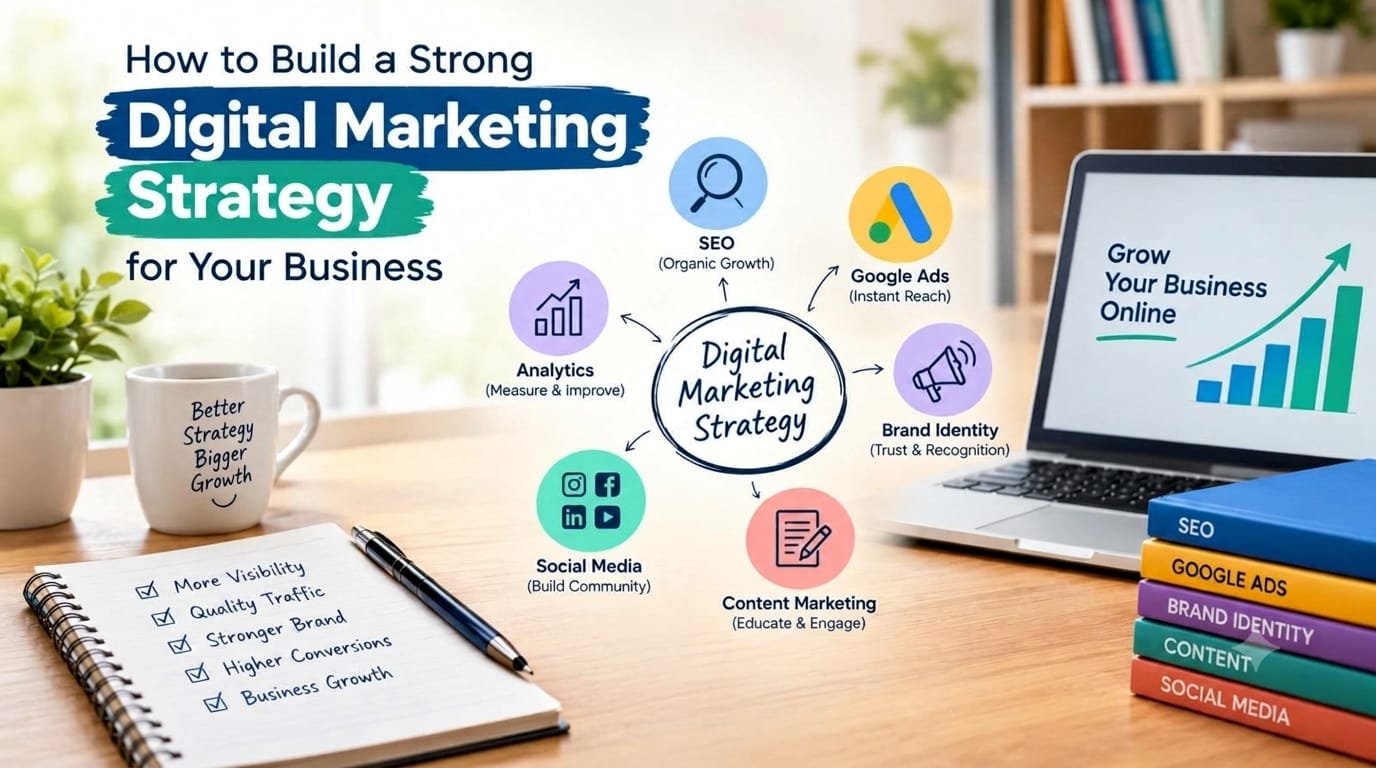
However, digital marketing is not about using one technique and expecting immediate results. A successful strategy combines different channels such as SEO, Google Ads, content marketing, social media, and brand identity to create a consistent online presence.
In this guide, we will explore how to build an effective digital marketing strategy and how SEO, Google Ads, and brand identity can work together to support business growth.
What Is a Digital Marketing Strategy?
A digital marketing strategy is a structured plan for promoting a business, product, or service through online channels.
It involves understanding your target audience, setting measurable goals, choosing the right marketing channels, creating useful content, and regularly analyzing performance.
A typical digital marketing strategy may include:
- Search Engine Optimization (SEO)
- Google Ads and paid advertising
- Content marketing
- Social media marketing
- Email marketing
- Brand building
- Conversion rate optimization
- Website optimization
- Analytics and performance tracking
The goal is not necessarily to use every available channel. Instead, businesses should identify the channels that best match their audience, goals, budget, and industry.
Why Does Your Business Need a Digital Marketing Strategy?
Without a clear strategy, businesses may spend money and time on different marketing activities without knowing whether those activities are producing meaningful results.
A well-planned strategy can help you:
- Reach your target audience
- Increase online visibility
- Generate qualified website traffic
- Build brand awareness
- Generate leads
- Increase conversions
- Improve customer engagement
- Measure marketing performance
- Make better use of your marketing budget
A strategy also helps ensure that different marketing activities are working toward the same business objectives rather than operating separately.
Step 1: Understand Your Target Audience
The foundation of any successful digital marketing strategy is understanding your audience.
Before choosing keywords, creating advertisements, or publishing content, determine who you want to reach.
Consider factors such as:
- Age
- Location
- Profession
- Interests
- Buying behavior
- Problems and challenges
- Search behavior
- Budget
- Purchase intent
For example, a local dental clinic and an online software company will have completely different target audiences and digital marketing requirements.
Understand Customer Search Intent
Search intent is particularly important for SEO and paid advertising.
Someone searching for:
“What is SEO?”
is probably looking for information.
Someone searching for:
“SEO agency near me”
may be actively looking for a service provider.
Understanding this difference helps businesses create the right content and advertisements for each stage of the customer journey.
Step 2: Define Clear Marketing Goals
Your digital marketing strategy should have measurable goals.
Instead of simply saying:
“I want more website traffic.”
create a specific objective such as:
“Increase organic website traffic by 30% over the next six months.”
Depending on your business, your goals could include:
- Increasing organic traffic
- Generating more leads
- Increasing online sales
- Reducing cost per lead
- Increasing brand awareness
- Improving conversion rates
- Increasing repeat customers
Clear goals make it easier to determine whether your marketing strategy is working.
Step 3: Build a Strong Brand Identity
Your brand identity plays an important role in digital marketing because it determines how customers recognize and perceive your business.
Brand identity includes elements such as:
- Logo
- Brand colors
- Typography
- Brand voice
- Visual style
- Values
- Mission
- Overall customer experience
A consistent identity can make your business more recognizable across your website, advertisements, social media platforms, and other digital channels.
For a deeper explanation of this topic, you can internally link this section to your existing article:
Understanding the Importance of Brand Identity
Why Brand Consistency Matters
Imagine a customer sees your Google advertisement with one visual style, visits your website with a completely different style, and then finds your social media page using different colors and messaging.
This can create an inconsistent experience.
Maintaining consistency across your digital channels helps customers recognize your business more easily and creates a more unified online presence.
Step 4: Use SEO to Build Organic Visibility
Search Engine Optimization (SEO) is one of the most important components of a long-term digital marketing strategy.
SEO focuses on improving your website and content so that search engines can better understand your pages and users can find them through relevant searches.
An SEO strategy may include:
- Keyword research
- On-page SEO
- Technical SEO
- Content optimization
- Internal linking
- Image optimization
- Website speed optimization
- Mobile optimization
- Local SEO
- Link building
Why SEO Matters
When people search for products, services, or information related to your business, appearing prominently in search results can help increase your website’s visibility.
However, SEO usually requires consistent effort. Businesses need to create useful content, optimize their websites, monitor performance, and improve pages over time.
You can link this section to your existing SEO article to provide readers with more detailed information about SEO.
Step 5: Use Google Ads for Paid Traffic
While SEO focuses on organic visibility, Google Ads allows businesses to pay for advertising placements across Google’s advertising network.
Google Ads can be useful when businesses want to reach people searching for specific products or services.
For example, a local business could target searches related to its services and direct users to a relevant landing page.
Important elements of a Google Ads campaign include:
- Keyword selection
- Ad copy
- Target audience
- Geographic targeting
- Budget
- Bidding strategy
- Landing page
- Conversion tracking
SEO vs. Google Ads
SEO and Google Ads serve different purposes.
SEO can help build organic visibility over time, while Google Ads can provide paid exposure based on campaign settings and budget.
Instead of viewing them as completely separate strategies, businesses can consider how both channels fit into their overall marketing plan.
You can internally link this section to your existing article:
SEO vs. Google Ads: Which Is Better for Your Business?
Step 6: Create High-Quality Content
Content is another major part of digital marketing.
Useful content can help businesses educate their audience, answer questions, demonstrate expertise, and attract visitors through search engines and social media.
Content can include:
- Blog posts
- Guides
- Videos
- Infographics
- Case studies
- Social media posts
- Email newsletters
- FAQs
- Product guides
Create Content Based on Customer Needs
Instead of creating content simply because you need to publish something, identify questions and problems your audience is actually searching for.
For example, a digital marketing company might create content around:
- SEO basics
- Google Ads
- Social media marketing
- Website optimization
- Branding
- Content marketing
- Conversion optimization
This approach allows content to support both users and broader marketing goals.
Step 7: Optimize Your Website for Conversions
Driving visitors to your website is only one part of digital marketing.
You also need to make it easy for visitors to take the next step.
Depending on your business, the desired action could be:
- Contacting your company
- Filling out a form
- Calling your business
- Purchasing a product
- Booking an appointment
- Signing up for a newsletter
- Requesting a quotation
Improve Your Website User Experience
A conversion-friendly website should generally have:
- Clear navigation
- Fast loading times
- Mobile-friendly design
- Easy-to-understand messaging
- Visible calls to action
- Relevant landing pages
- Trust-building information
- Simple contact forms
A visitor should be able to understand what your business offers and what they should do next without unnecessary confusion.
Step 8: Connect SEO, Google Ads and Brand Identity
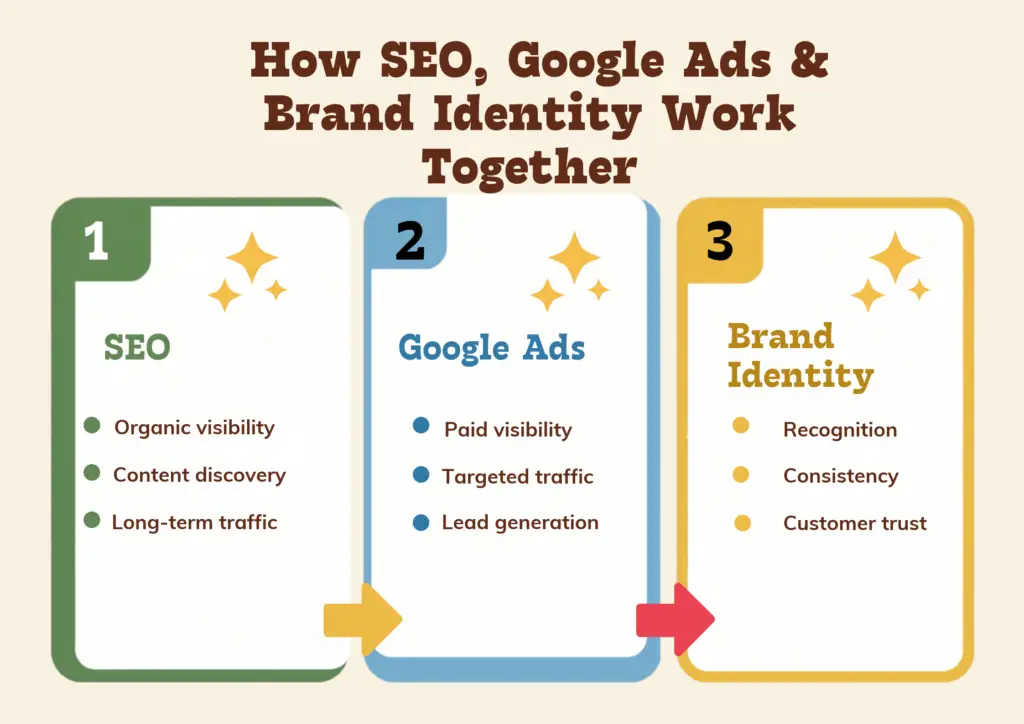
One of the biggest advantages of having a complete digital marketing strategy is that different channels can support one another.
Consider a simple example.
A potential customer searches Google for a service.
They may first discover your business through a Google Ad.
Later, they may see your organic search result.
They then visit your website and recognize your brand through consistent colors, typography, messaging, and visual identity.
These different touchpoints create a connected customer journey.
SEO + Google Ads
SEO can focus on building organic visibility, while Google Ads can help businesses reach relevant audiences through paid campaigns.
Data from paid campaigns can also provide insights into keywords, messaging, and landing pages that may be useful when developing broader marketing strategies.
SEO + Brand Identity
SEO brings people to your website, but your brand identity helps communicate who you are.
A well-optimized page with useful information and a consistent brand experience can support both discoverability and recognition.
Google Ads + Brand Identity
Advertisements are often one of the first interactions a potential customer has with a business.
Using consistent branding in advertisements and landing pages can create a more connected experience from the initial click to the website visit.
Step 9: Use Social Media to Support Your Strategy
Social media can help businesses distribute content, communicate with customers, showcase their brand, and increase awareness.
Depending on the target audience, businesses may use platforms such as:
- YouTube
- X
The right platform depends on where your target audience spends time and what type of content your business can consistently create.
Social media should not necessarily operate separately from your SEO and advertising strategy.
For example, a blog article can be transformed into:
- An Instagram carousel
- A LinkedIn post
- A short video
- An infographic
- An email newsletter
This allows one piece of content to support multiple marketing activities.
Step 10: Measure Your Digital Marketing Performance
A digital marketing strategy should be measured regularly.
Important metrics may include:
Organic Traffic
Measures the number of visitors coming from unpaid search results.
Click-Through Rate
CTR measures how frequently users click an advertisement or search result after seeing it.
Conversion Rate
Conversion rate measures the percentage of visitors who complete a desired action.
Cost Per Lead
For lead-generation campaigns, this metric helps businesses understand how much they are spending to acquire a lead.
Return on Ad Spend
ROAS can help evaluate the revenue generated relative to advertising expenditure when appropriate conversion and revenue tracking are available.
Engagement
For content and social media, engagement metrics can help indicate how users interact with published content.
The most useful metrics depend on the specific goals of the campaign.
Common Digital Marketing Mistakes to Avoid
Even businesses that invest in digital marketing can make strategic mistakes.
1. Trying to Use Every Platform
Being present everywhere is not necessarily better.
Focus on channels that are relevant to your audience and business objectives.
2. Ignoring Mobile Users
A significant amount of online activity takes place on mobile devices, so your website and landing pages should provide a good mobile experience.
3. Focusing Only on Traffic
High website traffic does not automatically mean high sales.
Businesses should also monitor leads, conversions, customer quality, and other relevant business outcomes.
4. Using Inconsistent Branding
Different logos, colors, messaging, and visual styles across platforms can create an inconsistent customer experience.
5. Not Tracking Results
Without analytics and conversion tracking, it can be difficult to determine which marketing activities are producing meaningful results.
6. Expecting Immediate SEO Results
SEO often requires consistent optimization and content development. Businesses should establish realistic timelines and monitor progress over time.
How to Create a Digital Marketing Strategy Step by Step
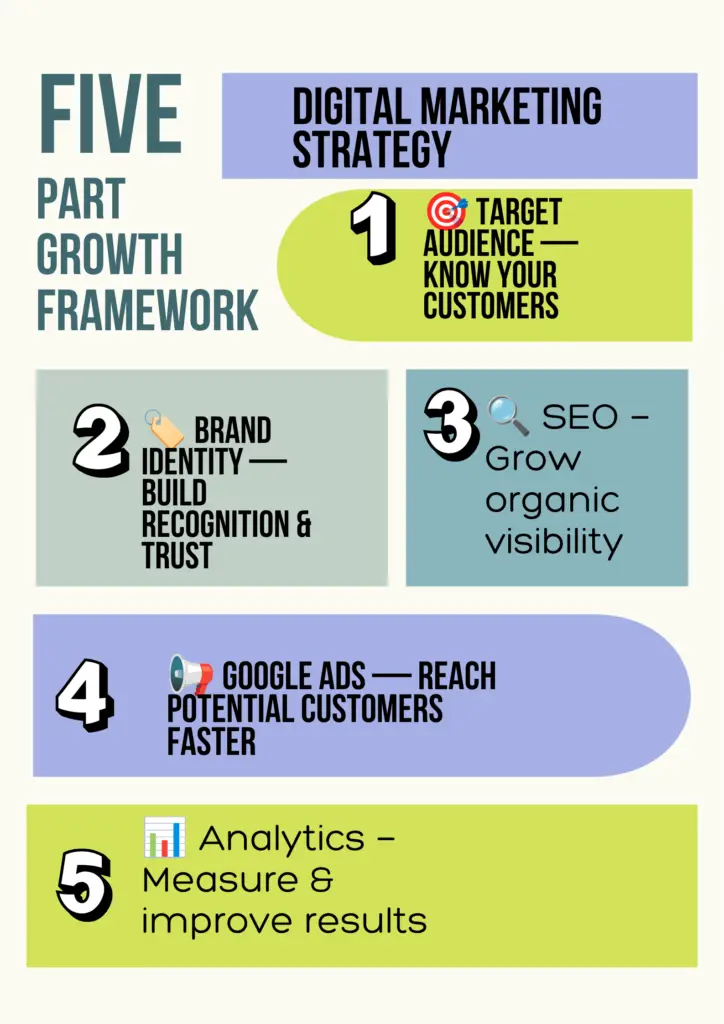
If you’re starting from scratch, you can follow this simple framework:
1. Define your target audience
Understand who your customers are and what they need.
2. Set measurable goals
Determine what you want your marketing activities to achieve.
3. Establish your brand identity
Create consistent visual and messaging guidelines.
4. Research keywords and competitors
Identify what your audience searches for and understand the competitive environment.
5. Develop an SEO strategy
Optimize your website and create useful content around relevant search topics.
6. Plan Google Ads campaigns
Identify suitable paid-search opportunities and create relevant landing pages.
7. Create valuable content
Develop content that answers customer questions and supports your business objectives.
8. Optimize your website
Make it easy for visitors to understand your offer and take action.
9. Track performance
Monitor relevant metrics and conversion data.
10. Improve continuously
Use performance data to identify opportunities for optimization.
Final Thoughts
Building a strong digital marketing strategy requires more than choosing individual marketing channels. It requires creating a connected system in which your SEO, Google Ads, brand identity, content, website, and other marketing activities support your overall business goals.
SEO can help build organic visibility, Google Ads can provide paid search exposure, and a consistent brand identity can help create recognition across different customer touchpoints.
The most important step is to start with a clear understanding of your audience and objectives. From there, choose the channels that make sense for your business, create useful content, measure your results, and continuously improve your strategy.
A well-planned digital marketing strategy is not a one-time activity. It is an ongoing process of understanding customers, testing ideas, measuring results, and adapting to changes in the digital landscape.