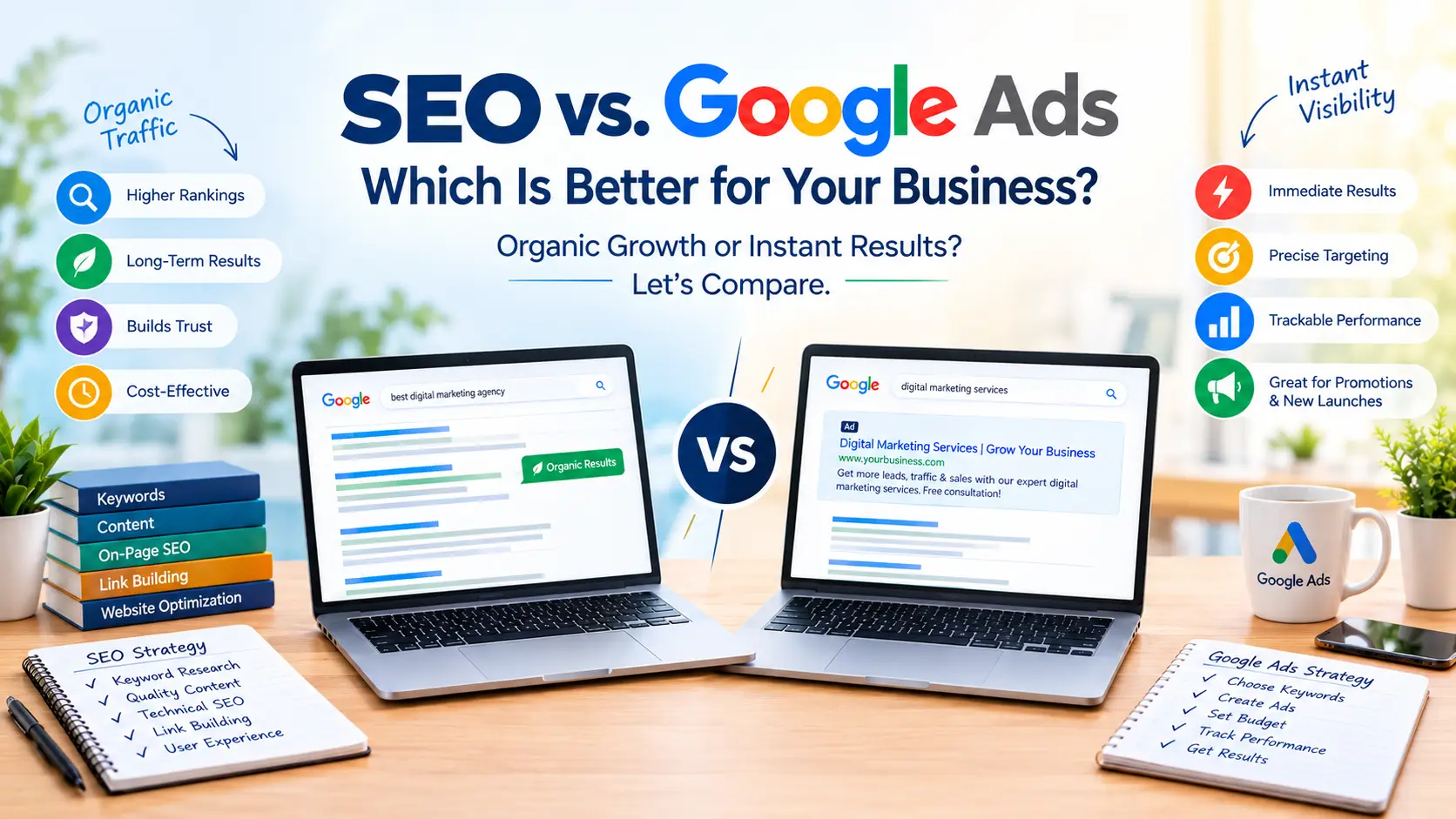
When businesses want to increase website traffic, generate leads, and attract new customers, two of the most popular digital marketing strategies are Search Engine Optimization (SEO) and Google Ads.
But which one is better for your business?
The answer depends on your goals, budget, industry, competition, and how quickly you need results. SEO can help build sustainable organic traffic over time, while Google Ads can put your business in front of potential customers almost immediately.
In this guide, we’ll compare SEO vs. Google Ads, explain how each strategy works, discuss their advantages and disadvantages, and help you decide which approach is right for your business.
What Is SEO?
Search Engine Optimization (SEO) is the process of improving a website so that it can rank higher in search engine results for relevant keywords.
For example, if you own a digital marketing agency and optimize your website for the keyword “digital marketing agency in Delhi,” your goal is to appear among the organic search results when someone searches for that term.
SEO generally involves several activities, including:
- Keyword research
- On-page SEO
- Technical SEO
- Content creation
- Internal linking
- Website optimization
- Link building
- Local SEO
- Improving page experience
Unlike paid advertising, you don’t pay Google every time someone clicks on an organic search result.
How Does SEO Work?
Search engines analyze websites using many different signals to determine which pages should appear for a particular search query.
A successful SEO strategy focuses on making a website:
- Relevant to the user’s search intent
- Easy for search engines to understand
- Fast and mobile-friendly
- Useful and trustworthy
- Well-organized
- Supported by quality content and relevant links
SEO usually requires consistent effort rather than a one-time campaign.
What Is Google Ads?
Google Ads is Google’s paid advertising platform. Businesses can create advertisements that appear in search results and across Google’s advertising network.
For example, a company selling web design services could create a Google Search ad targeting keywords such as:
“web design company near me”
When someone searches for a relevant keyword, the business may have an opportunity to show an advertisement above or below the organic search results.
Google Ads can be useful when businesses want to generate traffic, leads, sales, or phone calls quickly.
How Does Google Ads Work?
With Google Ads, advertisers select keywords, create advertisements, define targeting settings, and establish a budget.
Depending on the campaign and bidding strategy, advertisers may pay when someone clicks on their advertisement.
The cost can vary significantly depending on:
- Keyword competition
- Industry
- Location
- Search intent
- Quality of the advertisement
- Landing page experience
- Bidding strategy
- Audience targeting
SEO vs. Google Ads: Key Differences
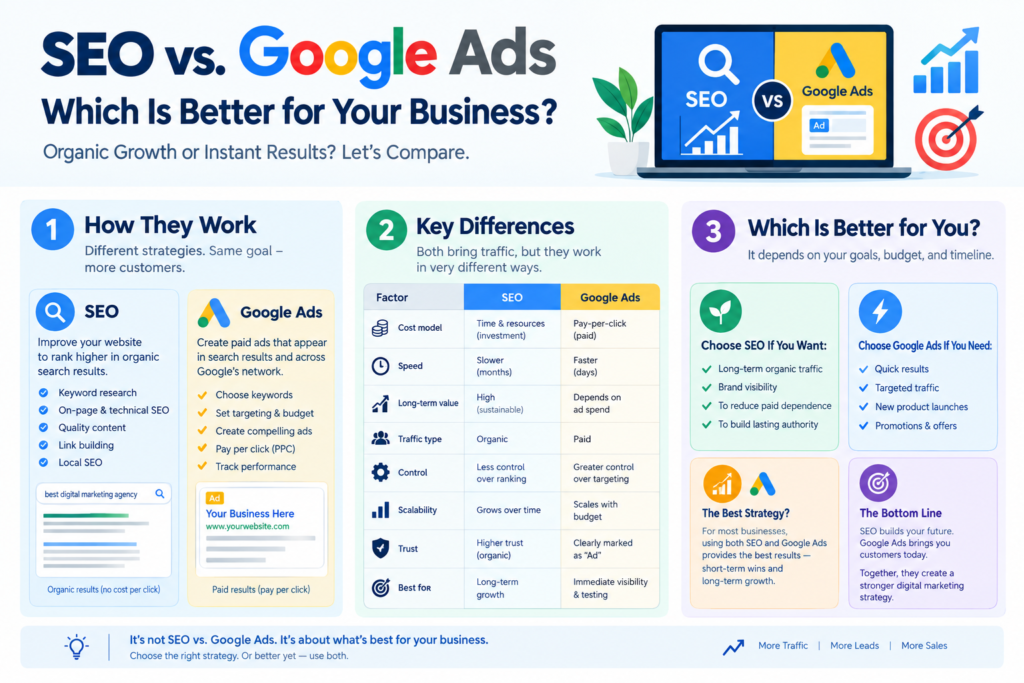
SEO and Google Ads can both generate search traffic, but they work in very different ways.
| Factor | SEO | Google Ads |
|---|---|---|
| Cost model | Primarily investment in time, content, and resources | Usually pay-per-click or other paid advertising models |
| Speed | Usually slower | Usually faster |
| Long-term value | High potential | Depends on continued ad spending |
| Traffic | Organic | Paid |
| Control | Less control over exact ranking | Greater control over targeting and campaign settings |
| Scalability | Can grow over time | Can scale with budget and campaign performance |
| Trust | Organic results may attract users who prefer non-paid listings | Clearly identified as advertisements |
| Best for | Long-term growth | Immediate visibility and testing |
SEO vs. Google Ads: Which Gives Faster Results?
If your main priority is speed, Google Ads generally has the advantage.
A properly configured Google Ads campaign can begin generating impressions and clicks soon after it becomes active.
SEO usually takes longer because search engines need time to crawl, understand, and evaluate your website and content. The amount of time required can vary based on your website’s authority, competition, technical condition, content quality, and target keywords.
Google Ads for Immediate Visibility
Google Ads can be particularly useful when:
- You are launching a new product
- You have a limited-time offer
- You need leads quickly
- You are entering a competitive market
- You want to test keyword demand
SEO for Long-Term Visibility
SEO is more suitable when your goal is to build a sustainable source of organic traffic.
A page that earns strong organic rankings can continue attracting visitors without paying for every individual click.
SEO vs. Google Ads: Which Is More Cost-Effective?
There is no universal winner when it comes to cost.
SEO doesn’t mean “free traffic.” Businesses often invest in SEO professionals, writers, developers, tools, content, link building, and technical improvements.
Google Ads requires an advertising budget and ongoing campaign management.
The important difference is the cost structure.
With Google Ads, increasing traffic generally requires additional advertising spend.
With SEO, the initial investment can continue producing value after the content and website improvements have been implemented.
For businesses focused on long-term growth, SEO can potentially provide strong returns over time.
For businesses that need immediate traffic and have a profitable conversion system, Google Ads can also provide excellent returns.
SEO vs. Google Ads: Which Is Better for Leads and Sales?
Both strategies can generate leads and sales.
However, performance depends heavily on search intent, targeting, landing pages, offers, and conversion optimization.
For example, someone searching:
“buy running shoes online”
may have stronger purchase intent than someone searching:
“best running shoes for beginners.”
Google Ads can be particularly effective for high-intent commercial keywords because businesses can target specific searches and send users directly to relevant landing pages.
SEO can also capture customers throughout the buying journey by creating content for informational, commercial, and transactional searches.
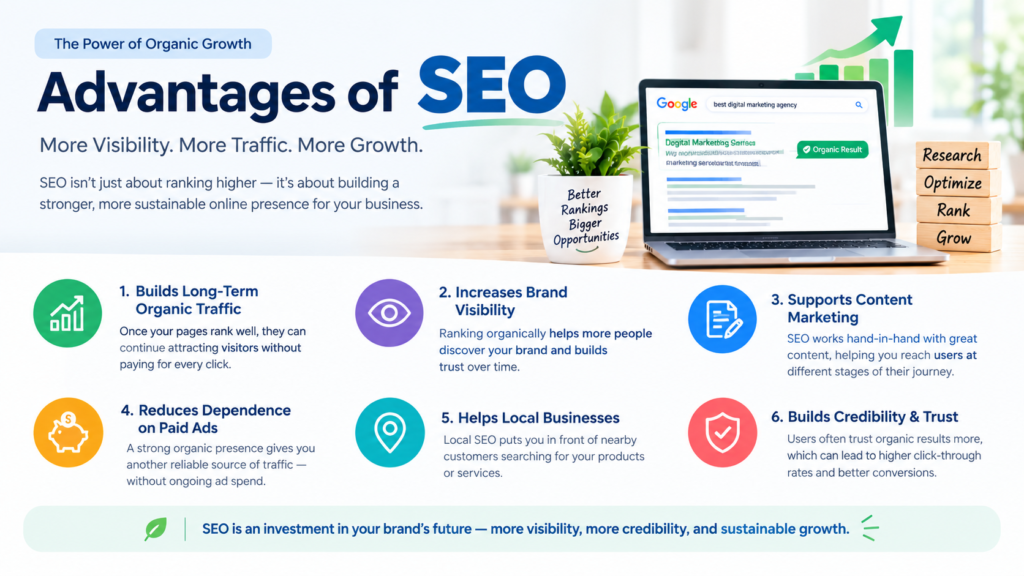
Advantages of SEO
1. Builds Long-Term Organic Traffic
One of SEO’s biggest advantages is its potential to generate traffic over an extended period.
Once a page earns strong rankings, it can continue attracting visitors without a direct advertising cost for every click.
2. Creates Brand Visibility
Ranking organically for relevant searches can increase brand awareness and establish your business as a useful source of information.
3. Supports Content Marketing
SEO and content marketing work closely together.
Businesses can create:
- Blog posts
- Guides
- Tutorials
- Case studies
- Product pages
- Service pages
- FAQs
These pages can target different search queries and attract users at different stages of the customer journey.
4. Can Reduce Dependence on Paid Advertising
A strong organic presence can provide another source of traffic instead of relying entirely on advertising.
5. Supports Local Businesses
Local SEO can help businesses appear for searches related to their products or services in specific geographic areas.
For example:
“best digital marketing agency in Delhi”
or
“dentist near me.”
Disadvantages of SEO
SEO also has challenges.
SEO Takes Time
It can take months to build meaningful organic visibility, especially for competitive keywords.
Rankings Are Not Guaranteed
Search engine rankings can change because of algorithm updates, competitors, technical issues, and changes in search behavior.
Requires Consistent Work
Successful SEO usually involves ongoing content, technical optimization, monitoring, and improvement.
Competitive Keywords Can Be Difficult
Some industries have highly competitive search results, making it difficult for newer websites to rank quickly.
Advantages of Google Ads
1. Fast Visibility
Google Ads can provide visibility much faster than organic SEO.
2. Precise Targeting
Businesses can control many campaign settings, including keywords, locations, audiences, budgets, and advertisements.
3. Easy Performance Tracking
Advertisers can monitor metrics such as:
- Impressions
- Clicks
- Click-through rate
- Cost per click
- Conversions
- Conversion rate
- Cost per conversion
4. Excellent for Testing
Google Ads can be used to test keywords, offers, landing pages, and messaging before investing heavily in long-term SEO.
5. Useful for Promotions
Paid search can be especially useful for seasonal promotions, new launches, events, and limited-time offers.
Disadvantages of Google Ads
1. Requires Continuous Budget
Once advertising stops, paid traffic can decline immediately.
2. Competitive Keywords Can Be Expensive
Some industries have expensive keywords because multiple advertisers compete for the same search terms.
3. Poor Campaign Management Can Waste Money
Incorrect targeting, irrelevant keywords, weak advertisements, or poorly optimized landing pages can result in inefficient spending.
4. Ad Blindness
Some users naturally prefer organic search results and may skip advertisements.
SEO vs. Google Ads: Which Should a Small Business Choose?
For many small businesses, the best approach isn’t necessarily choosing only one.
A combination of SEO and Google Ads can provide both short-term and long-term benefits.
For example:
Short Term
Use Google Ads to generate immediate traffic and leads.
Long Term
Invest in SEO and content marketing to build organic visibility.
Over time, your business can potentially reduce its dependence on paid traffic as organic visibility grows.
When Should You Choose SEO?
SEO may be the better choice if:
- You want long-term website traffic
- You are building a strong online brand identity
- You regularly publish useful content
- Your business operates in a stable market
- You want to reduce dependence on paid traffic
- You have time to invest in sustainable growth
SEO is particularly valuable for businesses that can benefit from informational and commercial search traffic.
When Should You Choose Google Ads?
Google Ads may be the better option if:
- You need customers quickly
- You are launching a new product or service
- You have a limited-time promotion
- You operate in a highly competitive organic market
- You have a strong landing page and conversion process
- You can measure a profitable return from advertising
Can You Use SEO and Google Ads Together?
Yes. In many cases, using both strategies can create a stronger digital marketing strategy.
For example, imagine a company sells accounting software.
It could use Google Ads to target high-intent keywords such as:
“accounting software for small business”
At the same time, the company could publish SEO content such as:
- How to choose accounting software
- Small business accounting tips
- Accounting software comparison
- How to manage business expenses
- Common accounting mistakes
Google Ads can capture immediate demand, while SEO can help build visibility for users researching their options.
SEO and Google Ads: A Better Digital Marketing Strategy
Instead of asking “SEO or Google Ads?”, businesses should often ask:
“How can SEO and Google Ads work together to achieve our marketing goals?”
A balanced strategy could look like this:
Step 1: Research Keywords
Identify keywords with relevant search intent and commercial potential.
Step 2: Launch Google Ads
Use paid campaigns to generate immediate traffic and test which keywords and offers convert.
Step 3: Create SEO Content
Build optimized pages around valuable keywords discovered through research and campaign data.
Step 4: Optimize Landing Pages
Improve page speed, messaging, calls to action, forms, trust signals, and overall user experience.
Step 5: Measure Results
Track organic traffic, paid traffic, leads, sales, conversion rates, and acquisition costs.
Step 6: Scale What Works
Invest more resources into channels, keywords, content, and campaigns that produce profitable results.
SEO vs. Google Ads: Which Is Better?
There is no single answer because SEO and Google Ads solve different problems.
If you need immediate visibility, Google Ads can be the better choice.
If you want to build long-term organic visibility, SEO is usually the stronger investment.
If you want both immediate and sustainable growth, combining SEO and Google Ads can be an effective strategy.
Final Verdict
SEO is better for long-term growth, organic visibility, and building a sustainable traffic channel.
Google Ads is better for immediate visibility, targeted traffic, quick testing, and short-term campaigns.
For many businesses, the most effective strategy is not to choose one over the other. Instead, use Google Ads for immediate opportunities while building SEO as a long-term growth engine.
The right balance ultimately depends on your budget, business model, competition, customer journey, and marketing objectives.
Frequently Asked Questions
Is SEO better than Google Ads?
Neither is universally better. SEO is generally more suitable for long-term organic growth, while Google Ads is useful for generating targeted traffic quickly.
Is SEO cheaper than Google Ads?
SEO may become more cost-efficient over the long term, but it still requires investment in content, technical optimization, expertise, and ongoing work.
How long does SEO take to show results?
SEO results vary significantly depending on competition, website authority, content quality, technical factors, and the keywords being targeted. It generally takes longer than launching a paid search campaign.
Can I use SEO and Google Ads together?
Yes. Using both can help businesses generate immediate traffic through paid campaigns while developing sustainable organic visibility through SEO.
Which is better for a new website?
Google Ads can help a new website generate immediate visibility, while SEO can be developed simultaneously to build long-term organic traffic.
Should a small business invest in SEO or Google Ads?
The best choice depends on the business’s goals and budget. Businesses that need immediate leads may benefit from Google Ads, while those focused on long-term visibility may prioritize SEO. Many businesses can benefit from using both.