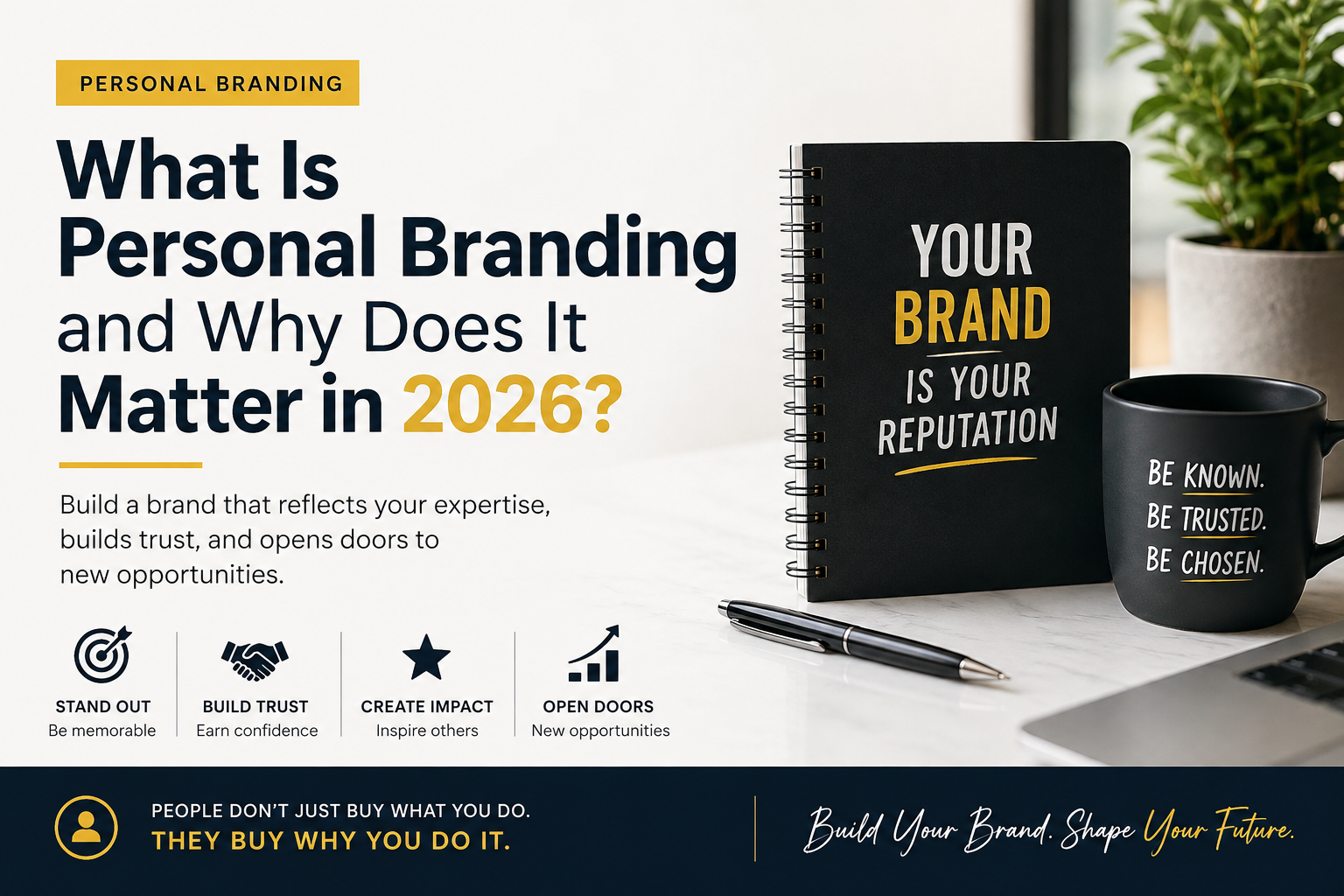
What Is Personal Branding and Why Does It Matter in 2026?
In a world where people can find almost anyone online within seconds, your personal brand has become one of your most valuable professional assets.
Whether you are an entrepreneur, consultant, executive, freelancer, creator, or professional building your career, people are forming opinions about you before they ever speak with you.
Personal branding is the process of intentionally shaping how people understand your expertise, experience, values, and unique perspective.
It is not simply about having a professional-looking LinkedIn profile or posting regularly on social media. A strong personal brand is about becoming known for something specific—and consistently demonstrating why people should trust you.
What Is Personal Branding?
Your personal brand is the combination of your reputation, expertise, personality, experience, and the value you bring to others.
Think of it as the answer to three questions:
- Who are you?
- What do you know or do exceptionally well?
- Why should people choose to listen to, trust, or work with you?
For example, saying that you are a “business consultant” is relatively generic.
A stronger position might be:
“I help early-stage founders turn complicated business ideas into clear, scalable growth strategies.”
The second statement is more specific. It tells people who you help, what problem you solve, and the value you provide.
That clarity is at the heart of effective personal branding.
Why Personal Branding Matters in 2026
1. People Google You Before They Trust You
Your online presence often becomes your first impression.
Potential clients, employers, business partners, investors, and collaborators may search your name before deciding whether to contact you.
If they find a clear and credible professional presence, you immediately have an opportunity to build trust.
If they find very little—or a confusing collection of outdated profiles—they may move on.
Your personal brand helps make sure that the story people discover online matches the professional reputation you want to build.
2. Expertise Alone Is No Longer Enough
Being excellent at what you do is important.
But expertise that nobody knows about has limited reach.
Personal branding allows you to communicate your knowledge publicly through articles, social media posts, videos, podcasts, presentations, interviews, case studies, and other forms of content.
Over time, consistently sharing useful ideas can transform you from someone who has expertise into someone who is recognized for that expertise.
That distinction can create significant professional opportunities.
3. A Strong Personal Brand Builds Trust
People prefer to work with people they recognize and trust.
A personal brand gives potential clients and customers the opportunity to understand how you think before they buy from you.
When your content consistently demonstrates your knowledge, opinions, values, and approach to solving problems, your audience begins to develop familiarity with you.
That familiarity can make the decision to work with you much easier.
Personal Branding Is More Than Social Media
One of the biggest misconceptions about personal branding is that it means becoming famous on social media.
It doesn’t.
You don’t need millions of followers.
You don’t even need to be active on every platform.
A strong personal brand can be built with a focused strategy around the channels that matter most to your audience.
For one professional, that might mean LinkedIn and a personal website.
For another, it could be YouTube, a newsletter, and speaking engagements.
The goal isn’t to be everywhere.
The goal is to be visible in the right places with the right message.
The Five Elements of a Strong Personal Brand
1. Positioning
Positioning defines what you want to be known for.
Your positioning should make it clear who you help, what you help them achieve, and what makes your approach different.
2. Expertise
Your expertise gives your brand credibility.
Share your knowledge generously. Explain difficult concepts. Discuss lessons from your experience. Offer practical solutions.
The goal is to demonstrate expertise rather than simply claiming it.
3. Personality
People don’t connect with résumés. They connect with people.
Your personality, opinions, stories, experiences, and communication style make your brand human.
You don’t need to share everything about your personal life. You simply need enough personality for people to understand the person behind the expertise.
4. Consistency
A strong brand isn’t created by one great post.
It is built through repetition.
Your visual identity, messaging, topics, tone, and values should feel consistent across your website, LinkedIn profile, social media, presentations, and other professional touchpoints.
5. Proof
Don’t just tell people what you can do.
Show them.
Client results, testimonials, case studies, projects, media appearances, certifications, speaking engagements, and examples of your work can all strengthen your credibility.
How to Start Building Your Personal Brand
You don’t need a complicated strategy to get started.
Begin with these five steps.
Step 1: Define your audience.
Who do you want to attract?
Clients? Employers? Investors? Business partners? Speaking opportunities?
Be specific.
Step 2: Choose your area of expertise.
Identify the subjects you want to become known for.
Ideally, choose an area where your experience, knowledge, and genuine interest overlap.
Step 3: Create your positioning statement.
Explain who you help, what you help them accomplish, and your unique approach.
Step 4: Build your online foundation.
Make sure your LinkedIn profile, website, professional biography, profile photo, and other important digital assets communicate the same story.
Step 5: Share valuable content consistently.
Teach what you know.
Share your perspective.
Tell stories.
Break down complex problems.
Discuss lessons you’ve learned.
Answer the questions your ideal audience is already asking.
Over time, this creates a body of work that demonstrates your expertise.
The Biggest Personal Branding Mistake
The biggest mistake is trying to appeal to everyone.
When your message is designed for everyone, it usually becomes memorable to no one.
Instead, become specific.
Rather than trying to be known as a “marketing expert,” consider what particular audience and problem you want to own.
For example:
“I help B2B technology founders build founder-led brands that generate trust and qualified leads.”
That positioning is easier to understand—and easier to remember.
Your Personal Brand Is a Long-Term Asset
A personal brand isn’t a quick marketing campaign.
It is an asset that becomes more valuable as you build credibility, relationships, content, and proof over time.
Every useful article you publish, every valuable conversation you have, every successful client result, and every insight you share can contribute to your professional reputation.
The goal isn’t to become an internet celebrity.
The goal is to become the person people think of when they need the expertise you provide.
Final Thoughts
In 2026, your reputation doesn’t exist only in the rooms you physically enter.
It also exists online—in your search results, social profiles, website, content, interviews, reviews, and conversations.
That makes personal branding more than a marketing trend. It is a strategic investment in your professional future.
You already have a story, experience, knowledge, and expertise.
The question is:
Are you intentionally building a brand around them?
If you’re ready to turn your expertise into a clear, credible, and memorable personal brand, start by defining what you want to be known for—and then consistently show the world why you are worth remembering.
Ready to build a personal brand that creates opportunities?
Let’s turn your expertise into a brand people recognize, trust, and remember.